Building and maintaining large-scale applications in 2025 requires a level of structure and consistency that goes far beyond basic syntax or framework familiarity. As teams grow and distributed development becomes the norm, the ability to enforce predictable architecture and maintain high standards across multiple contributors becomes a decisive competitive advantage. This is where JavaScript patterns provide measurable value. They introduce proven, repeatable ways to organize logic, reduce complexity, and create codebases that scale without collapsing under their own weight.
Modern engineering challenges reflect this need for structure. Enterprise teams frequently struggle with duplicated logic, inconsistent architecture, unpredictable state flow, and hard-to-maintain feature extensions. These issues were highlighted in a recent industry analysis on common pitfalls in enterprise applications, specifically in the article titled 7 JavaScript pitfalls to avoid in enterprise apps. The underlying message is clear: without established architectural conventions, teams face unnecessary operational risk. JavaScript patterns offer a systematic response to that challenge.
At the same time, the JavaScript ecosystem continues to evolve rapidly. New APIs, modern build pipelines, and advanced tooling have changed how applications are composed and deployed. With these shifts, the patterns that guide large-scale engineering must remain current. This article focuses on five JavaScript patterns that directly contribute to improved code reliability, clearer architecture, and long-term maintainability.
By understanding how JavaScript patterns shape software across growing teams, readers will gain a foundation for building applications that are easier to extend, audit, and optimize. The goal is to provide a clear, actionable reference for architects, senior developers, and technical teams who need a structured approach to long-term JavaScript development.
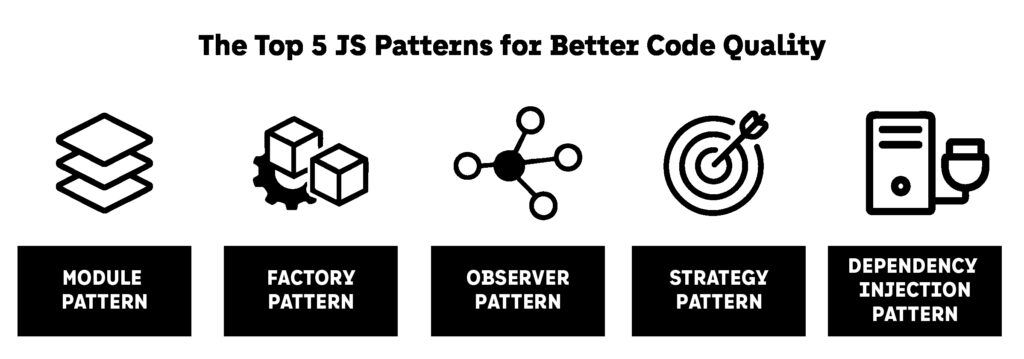
The following checklist summarizes the five JavaScript patterns that significantly improve code quality in large-scale applications. Each JavaScript pattern is selected for its ability to simplify architecture, reduce technical debt, and maintain structure across expanding teams.
- Use the Module Pattern to organize features into isolated, maintainable units.
- Apply the Factory Pattern to create consistent object generation for complex features.
- Implement the Observer Pattern when coordinating events across distributed components.
- Leverage the Strategy Pattern to swap logic dynamically without disrupting surrounding code.
- Adopt the Dependency Injection Pattern to remove hard-coded dependencies and increase application flexibility.
Pattern 1: Module Pattern
The Module Pattern is one of the most widely adopted structural approaches in modern engineering because it creates predictable boundaries, reduces unintended dependencies, and improves clarity across large projects. For teams operating at scale, consistent use of JavaScript patterns such as the Module Pattern prevents fragmentation and maintains a coherent architectural style even as dozens of contributors work in parallel.
What the Module Pattern Is
The Module Pattern is a structural approach that organizes logic into isolated units with clearly defined responsibilities. Each module exposes only the functionality that other parts of the application must access. Everything else remains private and internal. This separation protects the integrity of the code, reduces accidental coupling, and makes it easier to trace where specific responsibilities live, as you can understand in this detailed breakdown of different JavaScript patterns, including the Module Pattern, which highlights how modern ES6 structures support long-term maintainability.
Why the Module Pattern Matters at Scale
Large applications often suffer from uncontrolled growth. Features expand into other areas of the codebase, dependencies accumulate without design oversight, and critical functionality ends up scattered across unrelated files. This makes debugging harder and increases the likelihood of regressions. The Module Pattern reduces these risks by enforcing explicit interfaces and limiting how parts of the system communicate. Many organizations with distributed development teams rely on JavaScript patterns for this exact reason: they introduce guardrails that protect the architecture from unstructured growth.
By 2024 and 2025, full stabilization of ES modules across Node.js and browsers made the Module Pattern even more essential, as you can see in this deep, technical explanation of how ES modules differ from older formats, providing context for why modern teams rely on ES modules for scalable architecture.
Real Example Using ES Modules
A common example from modern codebases involves modular authentication systems. Teams split responsibilities into modules such as auth-service.js, token-manager.js, and session-storage.js. Each module focuses on a specific part of the authentication flow. This structure supports clearer reasoning, better testability, and easier updates. It demonstrates how JavaScript patterns help maintain clarity even as domain complexity increases.
Code Demonstration
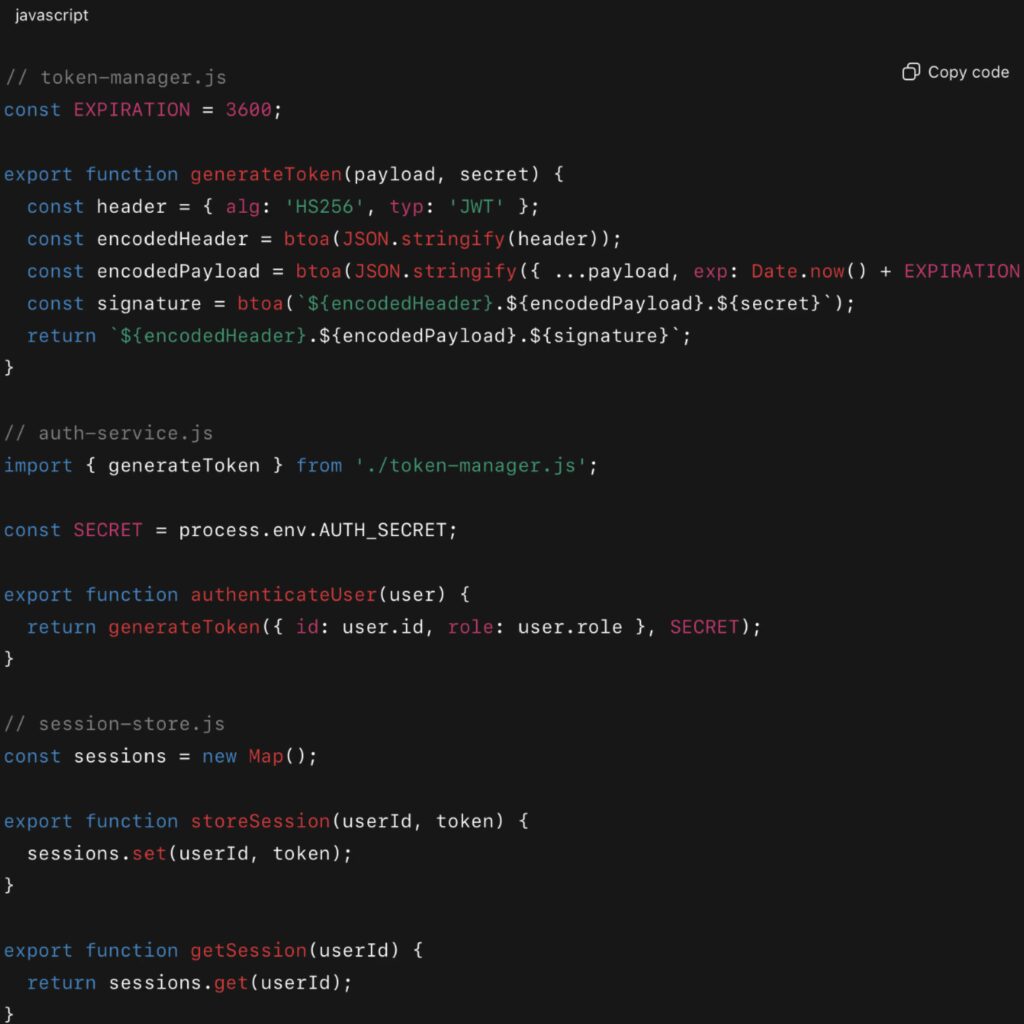
This example highlights three important characteristics of JavaScript patterns in modular design:
- Private logic is kept internal.
- Each module exposes only necessary functions through exports.
- High-level features, such as user authentication, compose multiple modules without requiring knowledge of their internal details.
Alignment With Modern Tooling
Tooling advancements in 2025 further strengthened the Module Pattern’s relevance. Modern bundlers and transpilers were optimized to interpret module boundaries more efficiently. This trend was highlighted in this bundlers and transpilers analysis, which examined how static module formats improve tree-shaking, caching, and processing parallelization. When modules follow consistent JavaScript patterns, these tools operate at peak efficiency.
Testing and Maintainability Benefits
Testing becomes significantly more reliable when functionality is isolated within modules. Each module can be tested independently, reducing complex setup and preventing cross-feature failures. These characteristics align well with continuous integration workflows, where isolated, predictable behavior is critical to avoid regressions. JavaScript patterns support this by enforcing structure at the architectural level.
Common Tradeoffs and How to Avoid Them
The Module Pattern can create challenges if used without discipline. Over-fragmentation leads to excessive file counts, and mixing ES modules with CommonJS can introduce compatibility issues. This medium article also outlines several pitfalls to avoid when transitioning older codebases into a module-first structure.
Best Practices for Applying the Module Pattern
- Group modules by domain rather than technical type.
- Keep export surfaces minimal and intentional.
- Use ES modules consistently across the application.
- Avoid deep nested directory structures.
- Pair modules with dedicated unit tests.
- Document shared contracts to maintain predictable integration.
When applied effectively, the Module Pattern supports clean architecture, efficient builds, and reliable testing practices. Its continued relevance in 2025 demonstrates how essential JavaScript patterns remain for engineering maturity and long-term software stability.
Pattern 2: Factory Pattern
The Factory Pattern is one of the most practical JavaScript patterns for large applications that must create multiple similar objects without duplicating logic or spreading configuration across the codebase. As systems grow, object creation becomes more complex, involving dynamic configuration, environment variables, user roles, external API integrations, or framework-specific attributes. The Factory Pattern standardizes this process and ensures that object creation remains predictable, testable, and consistent across teams, which is why it remains one of the most widely applied JavaScript patterns in modern software architecture.
What the Factory Pattern Is
The Factory Pattern abstracts the creation logic of objects so that consumers do not need to know how an object is assembled. Instead of building objects manually, developers call a factory function that handles initialization, defaults, validation, or dependency setup.
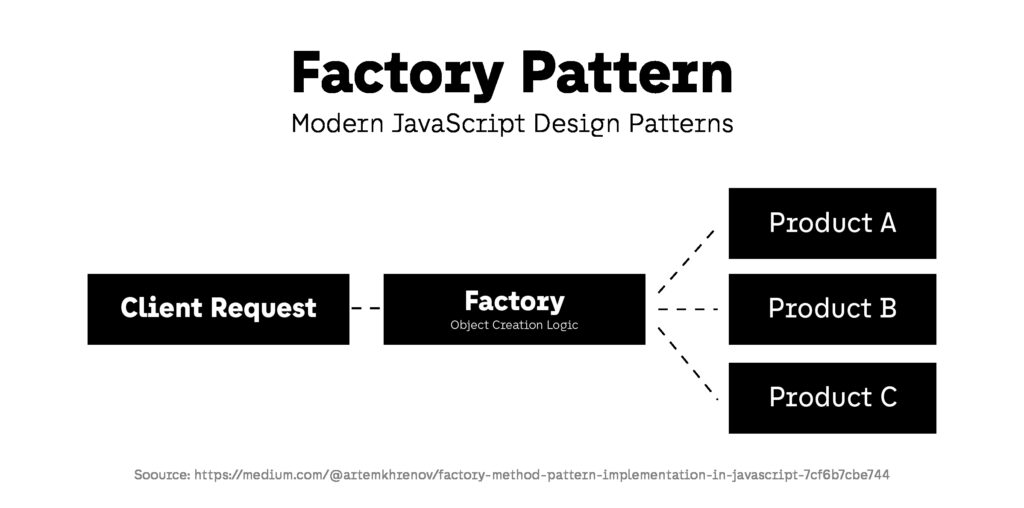
This makes architecture more resilient to change because modifications to object construction happen in one place. For enterprise engineering teams, JavaScript patterns like the Factory Pattern ensure that core responsibilities are centralized and easier to manage.
Why the Factory Pattern Matters at Scale
In large engineering environments, object creation frequently evolves over time. For example, services may begin with simple configuration and later require versioning, authentication, caching layers, or observability hooks. Without the Factory Pattern, these changes would require repeated updates across the codebase, increasing technical debt and the risk of inconsistent behavior.
The Factory Pattern prevents this by controlling object creation through a dedicated unit. This approach aligns with modern best practices described in current engineering resources such as the Nile Bits 2024 article, which highlights how centralized construction simplifies maintenance in fast-evolving applications.
By implementing factories early, teams gain flexibility to scale without breaking existing features.
Real Example from Engineering
A common modern use case involves API clients. Many organizations now interface with multiple versions of internal or third-party APIs. Rather than manually configure each client, a factory creates clients with the right base URLs, headers, retries, and monitoring hooks.
This ensures that even when APIs evolve, the rest of the system remains stable—one of the clearest advantages of using JavaScript patterns in complex architecture.
Code Demonstration
Below is a real-world style example used in 2024–2025 Node.js and frontend applications for creating standardized API clients.
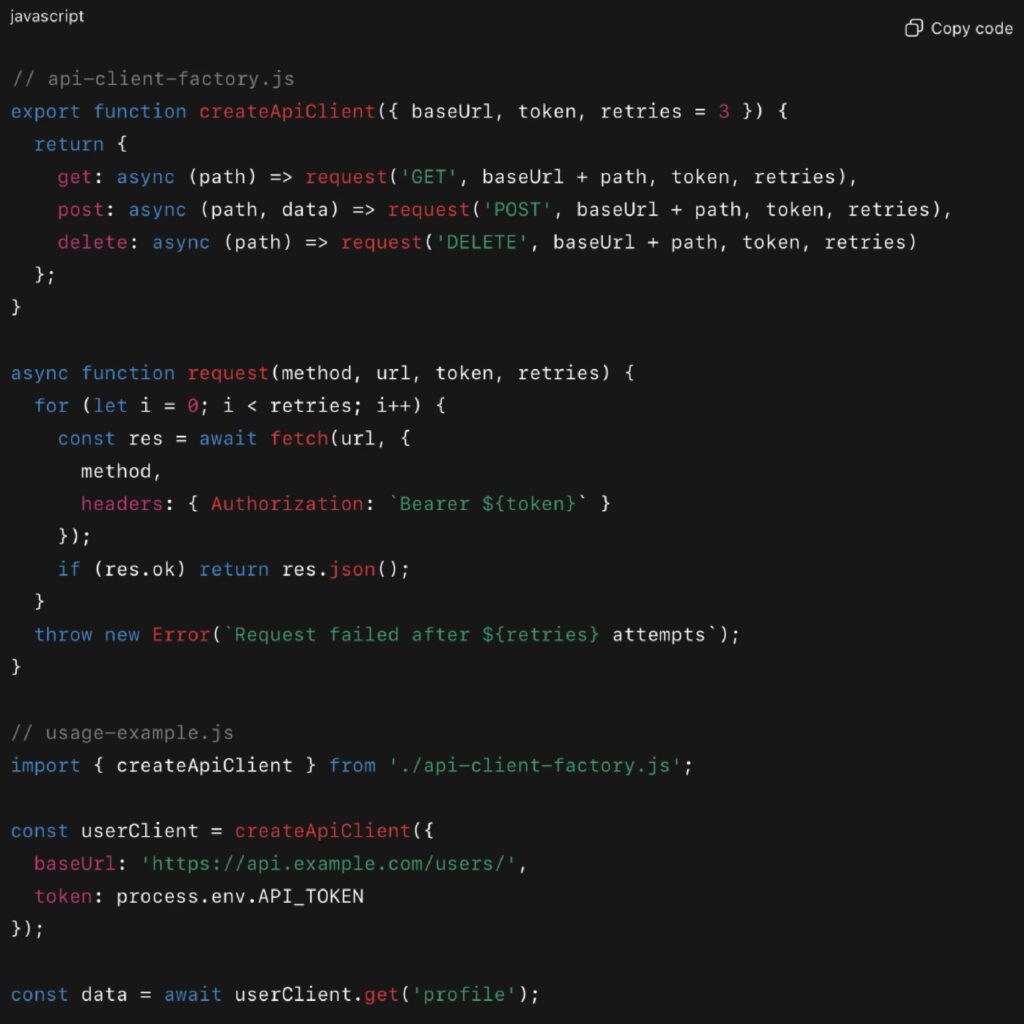
This example shows three key benefits of the Factory Pattern:
- All clients share a consistent interface.
- Complex behavior like retries or headers is centralized.
- Updates to the logic immediately benefit every feature that depends on the factory.
This aligns directly with the goals of JavaScript patterns: predictable architecture, minimal duplication, and cleaner long-term maintenance.
Common Tradeoffs
While the Factory Pattern solves many architectural issues, there are tradeoffs to consider:
- Factories can become overly generic if not documented clearly.
- Deeply nested factory structures can obscure the flow of data.
- Too much abstraction can make onboarding harder for junior developers.
These issues are mitigated by documenting the purpose of each factory and establishing consistent naming conventions—both essential when applying JavaScript patterns across large teams.
Best Practices for the Factory Pattern
- Keep factories focused on a specific domain (API, database, service).
- Avoid factories that accept excessively large configuration objects.
- Document each factory’s responsibilities clearly.
- Keep creation logic isolated and testable.
- Use factories when object creation is complex or varies by environment.
When used well, the Factory Pattern improves clarity and consistency, reducing long-term maintenance costs while allowing features to evolve safely. This makes it one of the most important JavaScript patterns for scaling large applications.
Pattern 3: Observer Pattern
The Observer Pattern is one of the most adaptable JavaScript patterns for managing interactions between independent components that need to respond to shared events or state changes. As modern applications become increasingly modular and event-driven, this pattern allows different parts of the system to remain synchronized without forcing tight coupling. By enabling components to subscribe to updates and react independently, the Observer Pattern ensures flexibility, predictable behavior, and cleaner communication across large codebases. This makes it an essential part of JavaScript patterns used in scalable front-end and back-end architectures.
What the Observer Pattern Is
The Observer Pattern defines a relationship between a subject, which manages state or data, and multiple observers, which subscribe to updates. When the subject changes, it notifies all observers, allowing each one to decide how to react. This structure removes the need for individual components to reference each other directly, and instead shifts communication into a standardized event system.
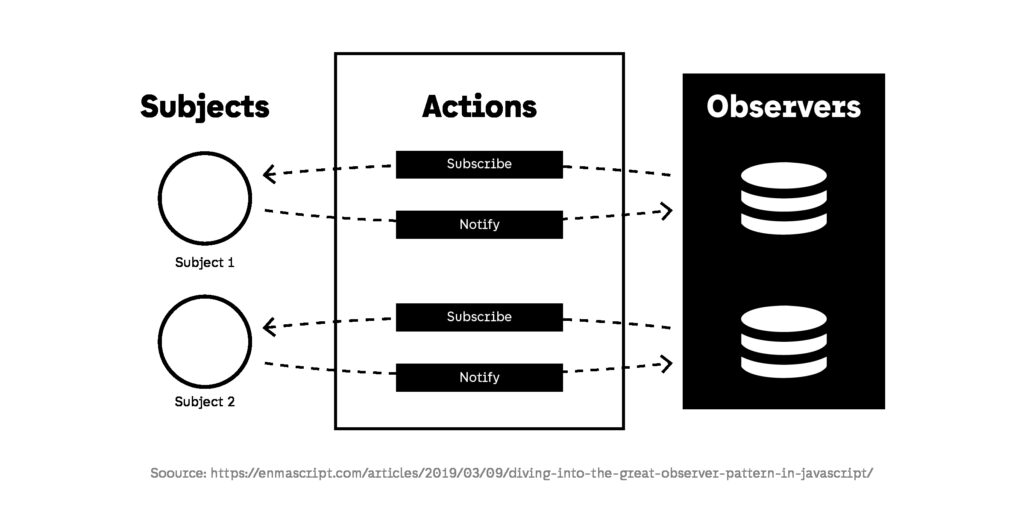
Among JavaScript patterns, this approach is especially useful in applications that rely on frequent UI updates, asynchronous workflows, or data streams.
Why the Observer Pattern Matters at Scale
Large distributed systems frequently process state from multiple sources: user interactions, real-time events, API responses, scheduled tasks, or internal analytics pipelines. When these interactions occur without an organized pattern, features tend to grow around ad hoc callbacks, nested handlers, or global variables, eventually creating fragile behavior. The Observer Pattern prevents these issues by centralizing communication around a subject, ensuring each module responds predictably while remaining independent.
A comprehensive explanation of this concept, which outlines how structured observer relationships reduce coupling, simplify debugging, and maintain clarity as systems evolve. These qualities support the long-term maintainability goals that drive the adoption of JavaScript patterns in enterprise engineering.
Real Example From 2024–2025 Engineering
A practical example appears in modern notification systems, search modules, and dashboard interfaces built with client-side frameworks. Many features rely on an event layer that triggers updates whenever new data becomes available. For example, a metrics dashboard may update charts whenever a background polling service retrieves new information. Each chart module acts as an observer, responding to changes without impacting other parts of the interface. Even as frameworks introduce abstraction layers, the underlying principle remains rooted in the Observer Pattern: independent components reacting to state changes through a shared event hub.
Code Demonstration
Below is a concise ES module example that reflects how the Observer Pattern is implemented in 2024–2025 applications:
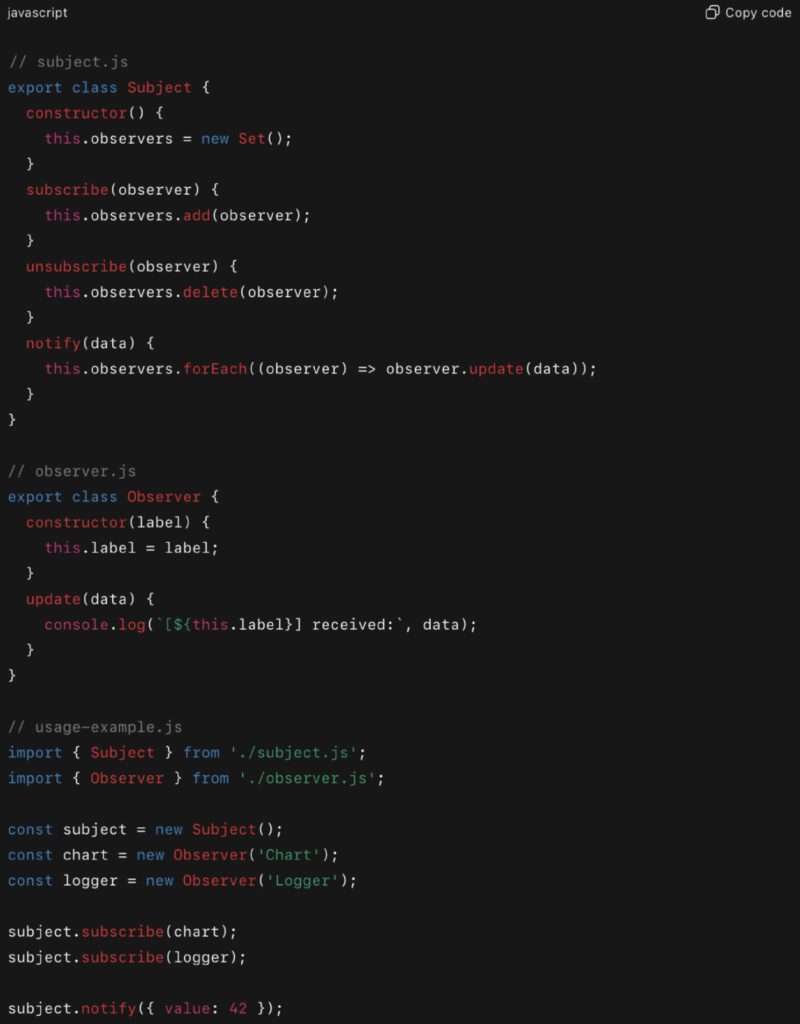
This example demonstrates the advantages of JavaScript patterns in real applications:
- The subject manages subscribers independently.
- Observers react to updates without knowing each other.
- Adding or removing observers does not affect existing logic.
Such flexibility is crucial for scalable architectures where more features and modules are added over time.
Common Tradeoffs
Although the Observer Pattern reduces coupling, it can obscure the flow of data if used without clear documentation. Excessive chaining of subjects and observers may also lead to hard-to-trace update cycles. Additionally, if observers perform heavy operations during updates, performance can degrade in high-frequency event systems.
Best Practices for the Observer Pattern
- Document subjects and the events they broadcast.
- Keep observers lightweight to avoid performance bottlenecks.
- Avoid deeply nested or chained subjects.
- Use descriptive naming for event types and update methods.
- Test observer behavior independently to ensure reliability.
When applied carefully, the Observer Pattern provides scalable structure for event-driven applications and remains one of the most important JavaScript patterns for managing complexity in modern systems.
Pattern 4: Strategy Pattern
The Strategy Pattern is one of the most adaptable JavaScript patterns for situations where multiple variations of an algorithm must coexist within the same application. Instead of scattering conditional logic or duplicating functions across the codebase, the Strategy Pattern isolates each behavior into its own module and provides a unified interface for switching between them. This makes the Strategy Pattern particularly effective in large engineering environments where flexibility, modularity, and predictable structure are essential for long-term maintainability. Because it isolates variation points cleanly, the Strategy Pattern continues to be one of the most valuable JavaScript patterns in modern architecture.
What the Strategy Pattern Is
The Strategy Pattern defines a family of algorithms, encapsulates each one, and makes them interchangeable at runtime. Instead of embedding different behaviors inside conditional structures, the Strategy Pattern separates each behavior into its own unit, while a controlling object decides which strategy to use.
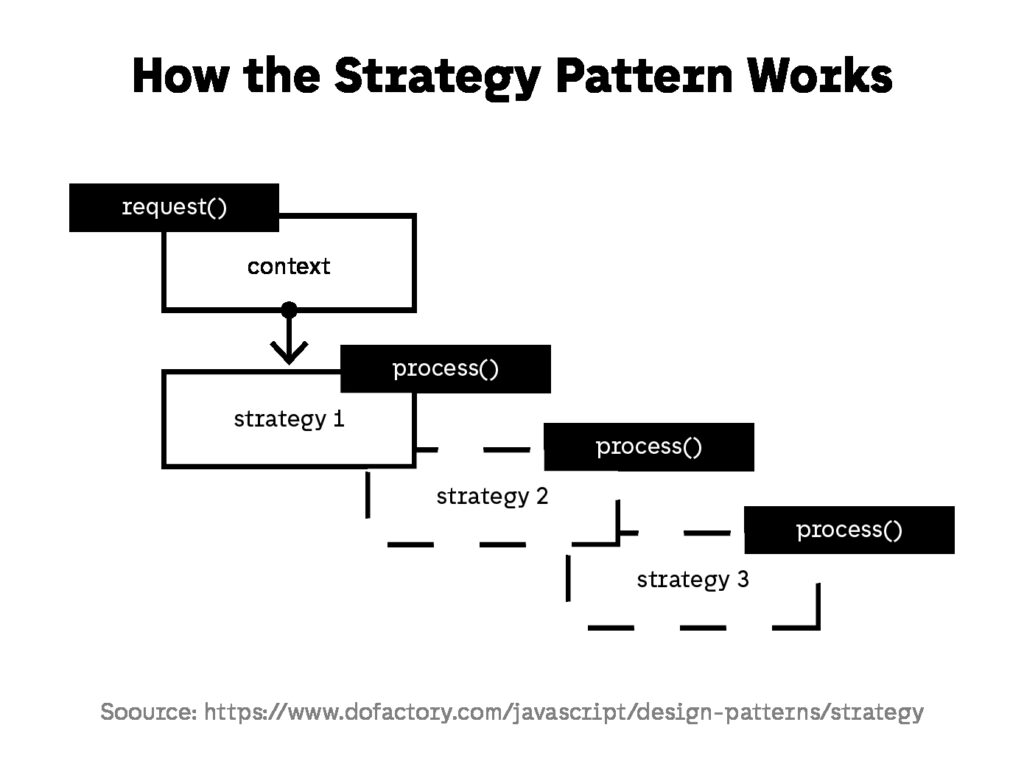
For teams operating at scale, this reduces complexity and reinforces the structural benefits promoted by many JavaScript patterns: clear separation of concerns, controlled dependencies, and consistent integration points.
Why the Strategy Pattern Matters at Scale
Large applications often require different behaviors for different contexts—payment rules per market, sorting rules per data set, logging behaviors per environment, or feature-level customizations for different clients. Without a clear pattern to manage these variations, teams typically resort to nested conditionals or duplicated functions scattered throughout the system. This approach becomes difficult to maintain as requirements evolve.
The Strategy Pattern solves this by offering a structured way to swap logic at runtime without modifying the surrounding system. This aligns strongly with the modularity principles highlighted in this engineering analysis, which examines how modern module structures support interchangeable logic units and reduce long-term coupling. When implemented consistently, the Strategy Pattern keeps code cleaner, more testable, and significantly easier to extend across multiple releases.
Real Example of Javascript Pattern – Strategy
A common use case in modern applications is data sorting or transformation. For example, dashboards may require different sorting behaviors depending on user role, region, or filtering preferences. Instead of writing conditional logic throughout the UI, each sorting behavior becomes a strategy. The application selects the right strategy based on configuration or user interaction. This keeps the UI logic clean while allowing new sorting strategies to be added without modifying existing code. This demonstrates how JavaScript patterns remain essential in systems that evolve quickly.
Code Demonstration
Below is a real-world style example frequently used in 2024–2025 front-end applications to manage interchangeable behaviors:
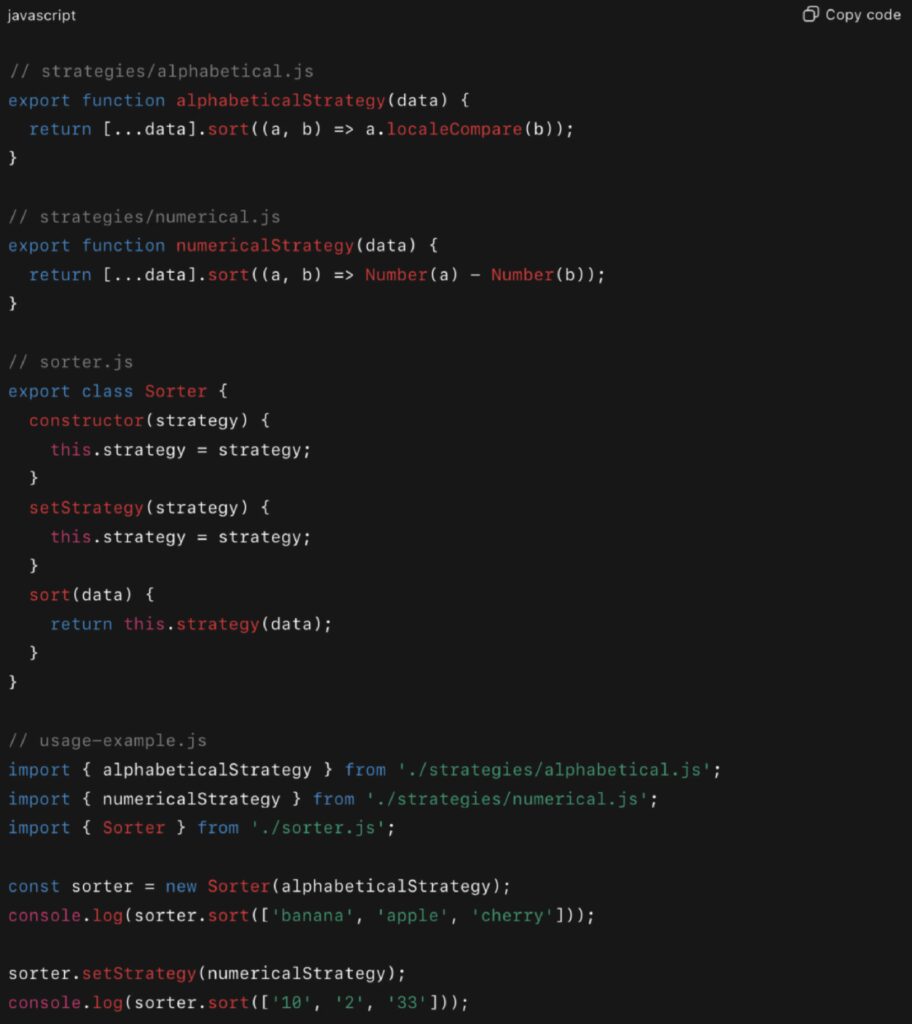
This example demonstrates three core advantages of using the Strategy Pattern:
- Each algorithm remains fully independent.
- Switching behaviors is controlled and explicit.
- The application can grow without modifying existing strategies.
These qualities are consistent with high-value JavaScript patterns that support predictable, scalable architecture.
Common Tradeoffs
While powerful, this pattern introduces new files and abstractions. If overused, it can fragment logic unnecessarily and make onboarding harder. Excessive strategies without clear naming also reduce clarity. These issues are manageable with documented guidelines and consistent directory structures—both key when applying JavaScript patterns across large teams.
Best Practices for the Strategy Pattern
- Keep each strategy tightly focused on one behavior.
- Avoid unnecessary abstraction; create strategies only when multiple behaviors truly exist.
- Store all strategies in a predictable structure.
- Document the purpose of each strategy clearly.
- Write unit tests for each algorithm to ensure predictable behavior.
When applied correctly, the Strategy Pattern improves modularity, reduces duplication, and supports architectures built around clean, interchangeable logic. This is why it remains a foundational choice among JavaScript patterns for teams building extensible, long-term applications.
Pattern 5: Dependency Injection Pattern
The Dependency Injection Pattern is one of the most important structural approaches for large-scale software systems because it separates object creation from object usage. As applications grow, tightly coupled components become a recurring source of instability and technical debt. The Dependency Injection Pattern solves this by allowing dependencies to be provided externally rather than instantiated directly within modules. This improves flexibility, supports testing workflows, and ensures that complex systems remain maintainable as they evolve. For organizations aiming to apply JavaScript patterns consistently across their architecture, dependency injection offers a clear path to reducing hidden complexity.
What the Dependency Injection Pattern Is
The Dependency Injection Pattern allows modules to receive their dependencies from the outside instead of constructing them internally. This means a module no longer decides how its collaborators are created; it only decides how they are used. In practical terms, this significantly reduces coupling between components, making the codebase more adaptable.
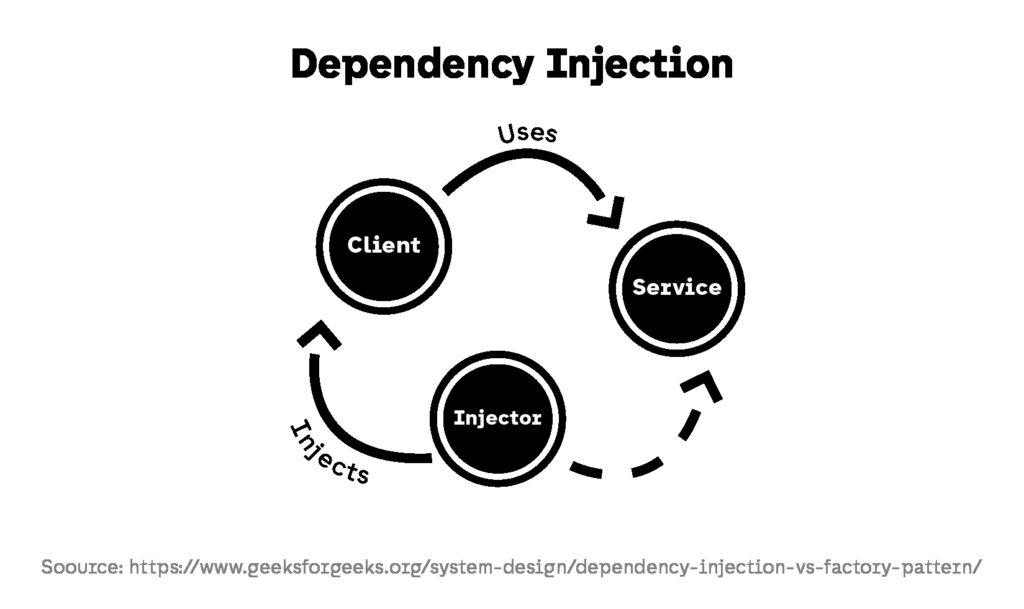
Teams that rely on JavaScript patterns benefit from this abstraction because it simplifies the process of replacing, extending, or upgrading services as systems grow.
Why the Dependency Injection Pattern Matters at Scale
At scale, applications rely on multiple layers of services—logging, caching, storage, network clients, monitoring agents, third-party SDKs, and more. Without dependency injection, these services are often instantiated throughout the codebase, making them difficult to configure consistently. The Dependency Injection Pattern centralizes these decisions, enabling clear configuration paths for all environments. This aligns with modern engineering practices highlighted in this article, which emphasizes how controlled, consistent service initialization contributes to stability in large front-end and full-stack systems. When teams adopt JavaScript patterns such as dependency injection, they improve not only their development workflow but also their operational reliability.
As companies continue to scale applications through microservices, serverless architectures, and distributed front-end systems, the ability to change dependencies without rewriting core logic becomes essential. This is why the Dependency Injection Pattern remains a cornerstone for teams focusing on long-term maintainability and engineering maturity.
Real Example
A common modern use case involves applications that interface with multiple analytics or logging providers. Rather than hard-coding a specific provider, a dependency injection approach allows the system to swap implementations depending on environment. For example, local development may use a lightweight logger, while production uses a feature-rich service with batching and alerting capabilities. This kind of scenario demonstrates how JavaScript patterns support growth without destabilizing the codebase.
Code Demonstration
Below is a concise example that reflects real-world dependency injection practices used in Node.js and front-end applications:
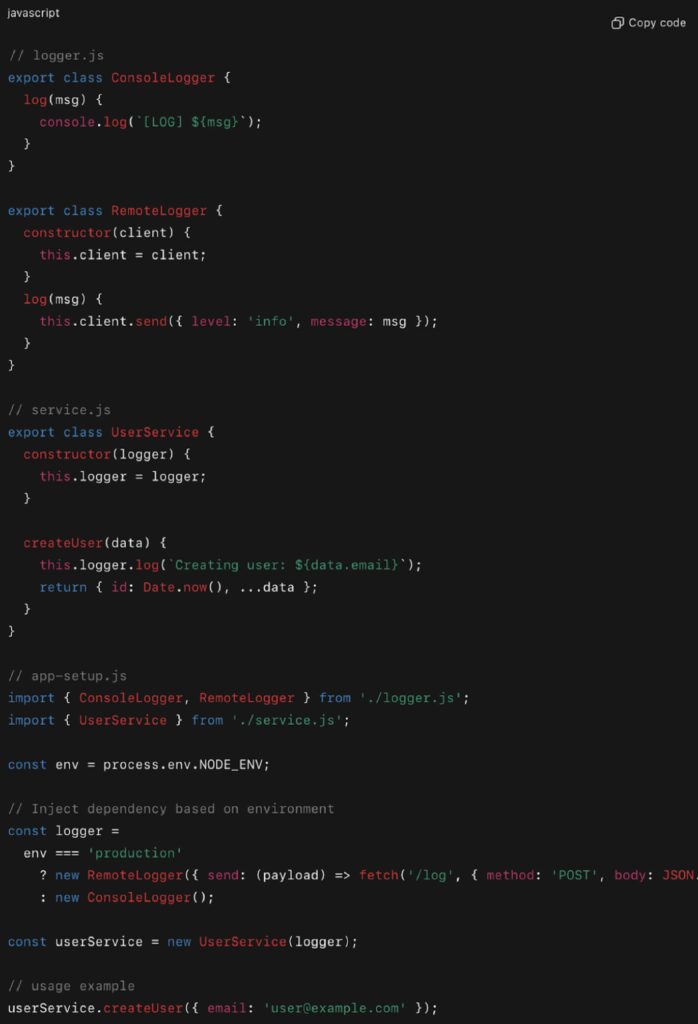
This example demonstrates three key advantages of Dependency Injection:
- Components accept external services instead of constructing them internally.
- Multiple implementations can be swapped in without rewriting the core component.
- Architecture remains predictable because dependencies follow consistent JavaScript patterns throughout the system.
Common Tradeoffs
The Dependency Injection Pattern introduces important advantages but also requires discipline. Excessively abstract containers can hide the flow of data, making debugging harder. Teams may also over-engineer injection mechanisms when simpler solutions would suffice. These issues are manageable with planning, documentation, and consistent application of JavaScript patterns across the architecture. When implemented carefully, dependency injection provides clarity rather than complexity.
Best Practices for the Dependency Injection Pattern
- Keep injection mechanisms explicit rather than relying on magic or hidden frameworks.
- Group dependencies logically to avoid scattered configuration.
- Ensure each service has a well-defined interface.
- Keep injected objects simple and predictable.
- Document shared dependency containers for easier onboarding.
- Use dependency injection to separate infrastructure concerns from business logic.
By following these practices, teams maintain clarity and reduce risk as applications grow. The Dependency Injection Pattern remains one of the most valuable JavaScript patterns for modern, scalable systems because it enforces clean architecture and provides the flexibility required in fast-changing environments.
How JavaScript Patterns Strengthen Scalable Architecture
Building and maintaining large applications requires consistent structure, predictable behavior, and clear separation of responsibilities. Throughout this article, the focus on JavaScript patterns has demonstrated how well-defined architectural decisions reduce long-term complexity and create software that grows without losing clarity. By applying JavaScript patterns systematically across teams and domains, organizations gain a foundation that supports stability, testing, team onboarding, and continuous improvement.
As modern engineering challenges continue to expand, applying JavaScript patterns ensures that new features can be integrated without destabilizing existing systems. This consistency is essential for organizations that operate in regulated or security-focused environments, where technical processes must align with documented quality controls. A strong architectural baseline also reinforces internal governance, improves audit readiness, and supports broader organizational standards.
This connection becomes clearer when considering how engineering maturity intersects with certification frameworks. For example, Fyld’s commitment to structured, secure practices is reflected in its ISO/IEC 27001 achievement. While JavaScript patterns do not directly confer certification, they contribute to the disciplined engineering culture required to support such standards. When teams implement patterns consistently, they reduce operational risk and reinforce the reliability expected in certified organizations.
Ultimately, sustainable software depends on decisions made long before deployment. By embedding JavaScript patterns into everyday engineering practice, teams ensure their applications remain maintainable, scalable, and resilient. This structured approach enables growth, supports quality, and prepares systems for the evolving demands of modern development.