AI has genuinely changed the economics of custom software development. Code that used to need a dedicated team and a multi-month timeline can now get a working first draft in days, and that’s pulling a real share of companies toward building instead of buying a ready-made tool. That part of the story is true and well documented. What’s less discussed is that building fast and building something that actually works, securely, and on budget are different problems, and the data on custom software development projects that skip straight from fast to finished is a lot less flattering.
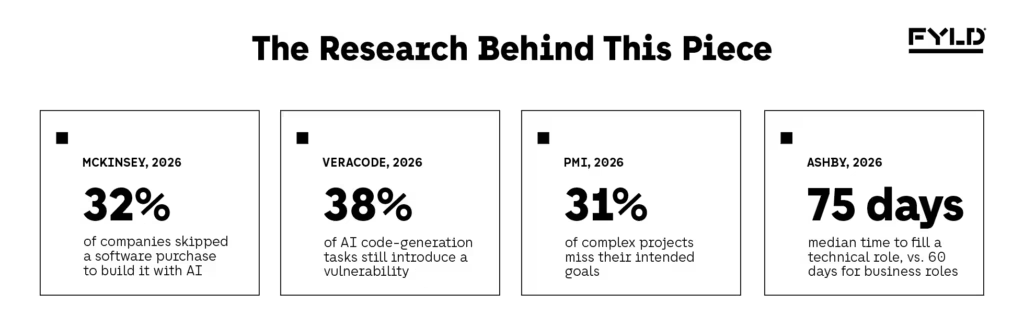
Seven findings below look at how far the shift toward custom software development has gone, what it’s actually costing companies who make that call without the right team behind it, and why the choice that matters most isn’t build versus buy. It’s who does the building.
None of this is a case against AI-assisted development. The tools genuinely compress the time between an idea and a working prototype, and that compression is real value. The findings below are about the second half of a custom software development project, the part after the first draft, where a prototype has to become something secure, maintainable, and actually worth what it cost to build. That’s where the data gets a lot more uneven.
The pressure to move fast isn’t coming from engineering teams alone. PMI’s own research into executive priorities found 93% of CEOs say their organization has to rethink its operating model at least every five years, and 72% name AI and automation as the single biggest driver of that reinvention. Custom software development sits right at the center of that pressure: it’s usually the fastest lever an organization has to act on a strategy decision, which is exactly why getting the “who builds it” question right matters more now than it did when software projects moved at a slower, more forgiving pace.
AI has made it cheaper to build than to buy
For most of the last decade, the default answer to “should we build this or buy it” was buy: a SaaS subscription was faster to stand up than a custom software development project, and cheaper to maintain than an internal team. AI coding tools have started to invert that calculus, and the shift shows up clearly in how companies describe their own purchasing decisions.
32% of companies skipped a purchase to build it themselves
McKinsey’s State of AI 2026 survey, fielded May through June 2026 across 1,719 respondents in 97 countries, found 32% of organizations decided against buying a piece of software because agentic coding tools made building it internally feasible. Among companies McKinsey classifies as AI high performers, that figure rises to nearly half, against 31% of everyone else.
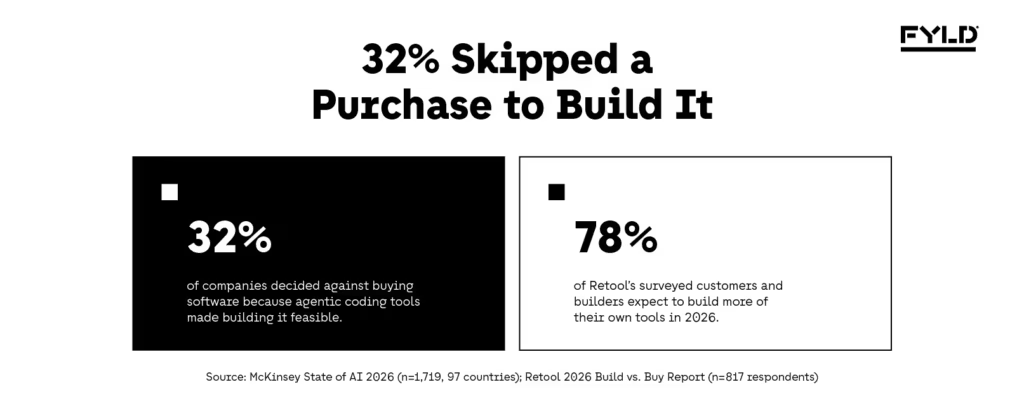
78% of Retool’s own customers expect to build even more next year
Retool’s 2026 Build vs. Buy Report found 35% of its surveyed customers and builders have already replaced at least one SaaS tool with a custom build, and 78% expect to build more of their own tools in 2026. Retool sells a platform for building internal tools, and its 817 respondents are its own customer base, so this is best read as what companies already leaning toward custom software development are doing, not a neutral market-wide figure. It’s still a useful data point once that’s accounted for: the same shift McKinsey measured independently shows up again here, from a different angle.
Individual productivity gains aren’t showing up as business results
Faster code isn’t automatically better code, and the same research documenting the build-it-yourself shift also documents the gap between feeling productive and actually producing something that holds up once it ships.
80% feel more productive, but only 37% see it in earnings
The same McKinsey survey found 80% of respondents say AI has improved their individual productivity, while just 37% of organizations attribute any earnings impact to AI at all, a figure essentially unchanged from 2025 even as the share of companies scaling AI enterprise-wide rose from 38% to 44%. Feeling faster and actually being more profitable turned out to be two different measurements, and most companies running a custom software development project are only seeing the first one.
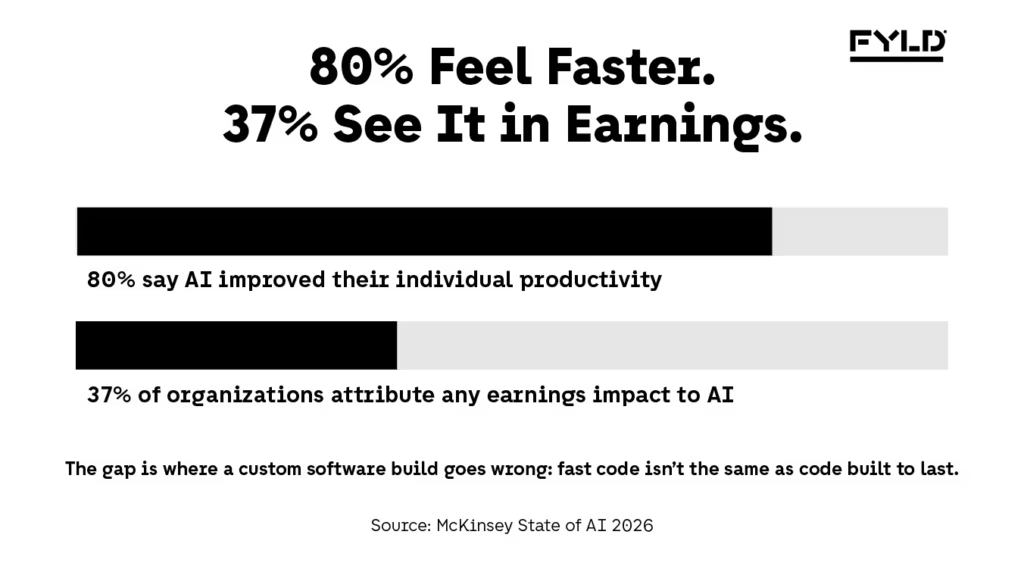
That gap is exactly where a custom software build can go wrong
A team can ship code faster with AI and still not produce something that moves the business. Speed at the task level doesn’t automatically translate into a system that’s well architected or built to survive contact with real users and real data. The organizations closing that gap aren’t the ones with the most AI tooling. They’re the ones who paired that tooling with people who’ve run a custom software development project before.
AI-generated code still fails security tests more than a third of the time
Speed and profitability aren’t the only places the gap shows up. The code itself carries a measurable share of risk, and it’s the one most custom software development conversations skip past entirely.
The average pass rate is 62%, with a 33-point gap between languages
Veracode’s 2026 GenAI Code Security Report, testing 18 AI models across four languages and four vulnerability categories, found the average security pass rate improved to 62% in its most recent update, up from 56% previously. That’s genuine progress, but it still means 38% of AI code-generation tasks introduced a known vulnerability. Python scored best at 64%, Java worst at 31%, a 33-point spread between the best and worst languages a custom software development team might actually be working in.
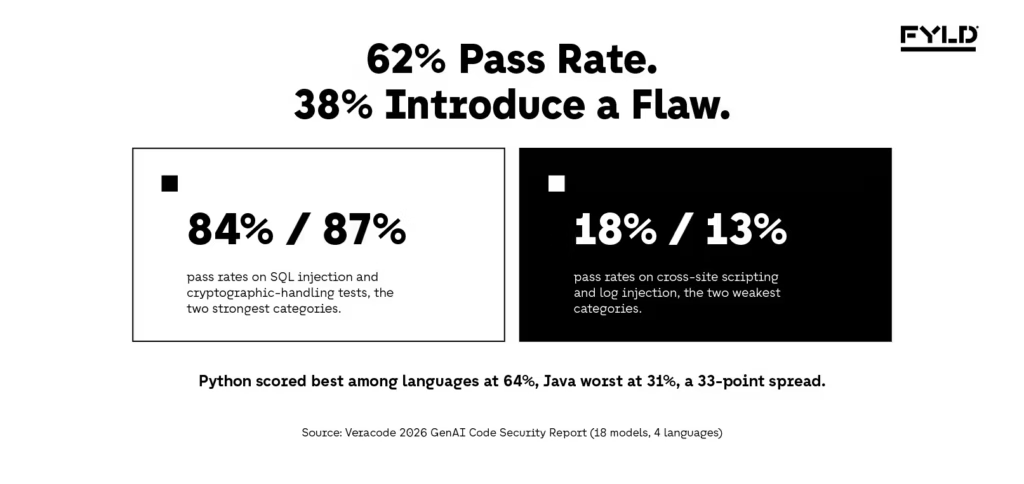
Two vulnerability categories are failing outright
The average pass rate hides how uneven the risk actually is by category. Models passed 84% of SQL injection tests and 87% of cryptographic-handling tests, but performance fell sharply on cross-site scripting, an 18% pass rate, and log injection, 13%. Those aren’t edge cases. They’re common vulnerability classes in real breaches, which is part of why Verizon’s 2026 Data Breach Investigations Report found 31% of breaches now start with a software vulnerability, overtaking stolen passwords as the single most common way attackers get in. A custom software development project that treats AI output as finished code, rather than a draft that still needs a security-literate reviewer, is building risk in alongside the features.
Complex projects fail at a rate PMI says is more than double the norm
Speed, profitability, and security aren’t the only places a custom software build can go wrong. PMI’s own research on project complexity shows the failure rate is highest in exactly the environment every AI-assisted build runs in right now.
31% of complex projects miss their goals
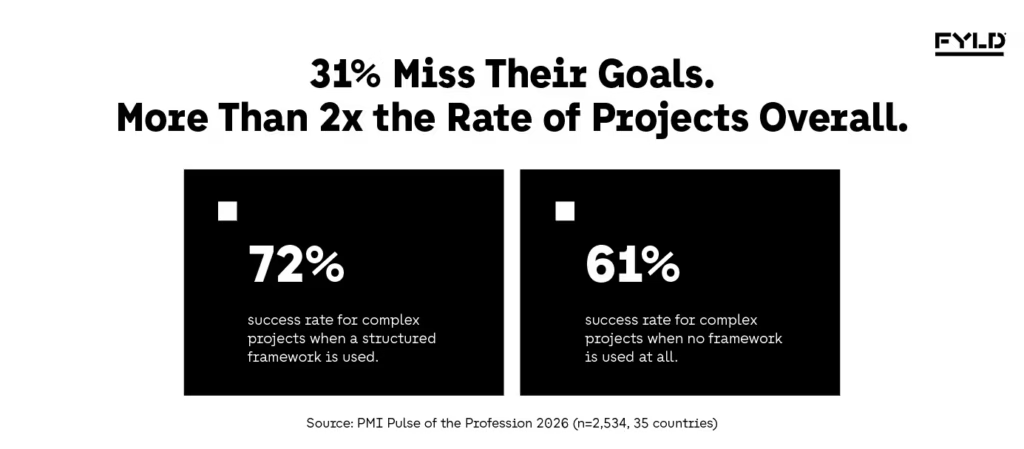
PMI’s Pulse of the Profession 2026, surveying 2,534 project professionals and senior leaders across 35 countries, found 31% of complex projects now fail to achieve their originally intended benefits, more than twice the rate PMI reports for projects overall. Forty-eight percent of project professionals cite faster technology and tool cycles as a key driver of that complexity, which is exactly the condition a custom software development project runs under when it’s built around AI tooling that changes every few months.
The gap between success and failure is process, not talent
PMI’s data points at what actually separates the projects that work from the ones that don’t: 72% of complex projects succeed when a structured delivery framework is applied, against 61% when none is used, and teams with a mature program office report 63% success managing complexity versus 57% without one. Four in five complex projects experience some negative fallout from poorly managed complexity, including delivery disruptions like missed deadlines, outcomes PMI explicitly ties to how a project is run rather than what it’s building. The tooling isn’t the differentiator. The discipline behind how a custom software development project gets run is.
Hiring the team to build it takes months you don’t have
None of this is an argument for doing nothing. It’s an argument for doing it with the right team, and assembling that team in-house runs into its own timeline problem before a single line of code gets written.
A nonexecutive hire takes 39 days before anyone writes a line of code
SHRM’s 2026 Recruiting Benchmarking report, drawing on data from more than 4,600 organizations, found the median time-to-fill for a nonexecutive role is 39 calendar days. That’s a general hiring benchmark across all functions, not engineering specifically, and it’s the floor, not the ceiling, for a technical hire. A company still has to run that same clock once for every engineer a custom software development project needs, not just once for the team as a whole.
A technical role takes 75 days to fill, against 60 for business roles
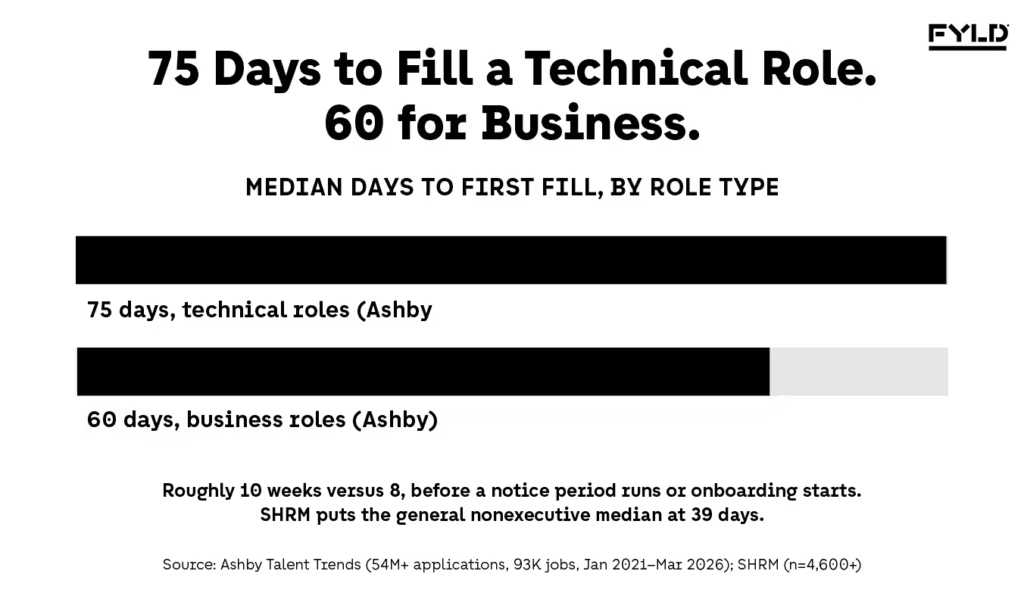
Ashby’s 2026 Talent Trends data, drawn from more than 54 million applications and 93,000 jobs between January 2021 and March 2026, found technical jobs take a median 75 days to first fill compared with 60 days for business roles. That’s roughly 10 weeks versus 8, measured from the day a requisition opens to the day someone starts, before notice periods or onboarding are even counted. A custom software development project that starts with a hiring plan is starting weeks, sometimes months, behind one that doesn’t.
The market is already shifting toward smaller, specialized partners
While individual companies weigh build versus buy on a single custom software development project, the broader market for technology services is already answering a related question: who gets trusted with specialized, project-based work. That answer is visible in how the biggest buyers of technology services are actually spending, not just in what they say they plan to do, which makes it a more reliable signal than any single company’s stated intentions.
Enterprises are turning to niche providers for exactly this kind of work
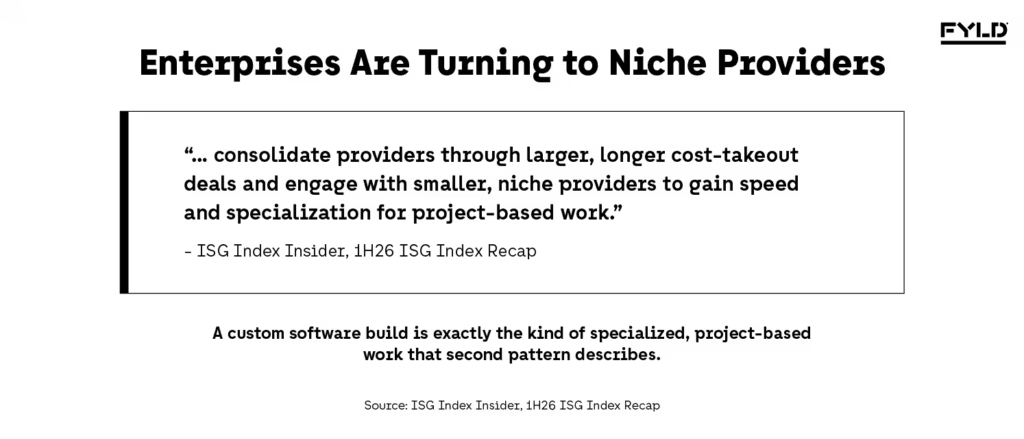
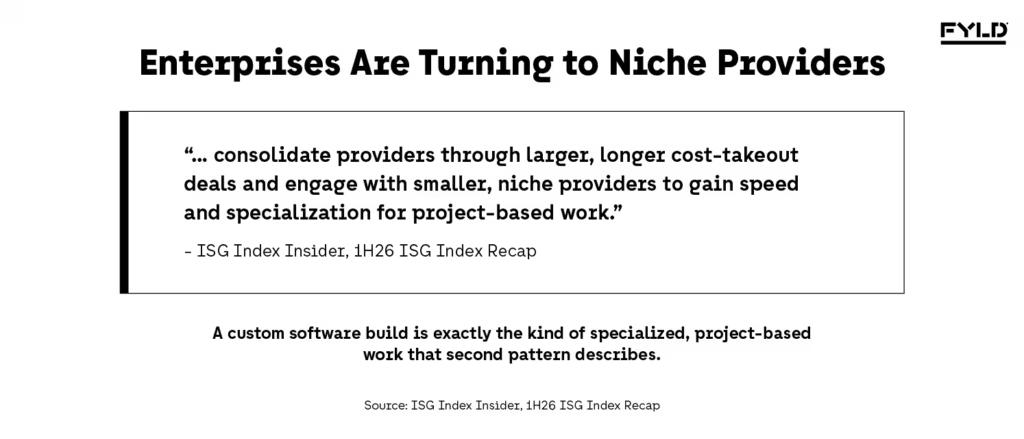
ISG’s Index Insider recap found enterprises continuing to “consolidate providers through larger, longer cost-takeout deals” while separately choosing to “engage with smaller, niche providers to gain speed and specialization for project-based work.” A custom software build is exactly the kind of specialized work that pattern describes, and it rewards providers whose people have done it before.
Experience matters more than the engagement model
What actually determines whether a custom software development project succeeds isn’t whether the engineers join the client’s team or deliver the project end to end. It’s whether they’ve already run a custom software development project like this one before, from first commit to production. An engineer who has shipped a similar system before brings judgment a first-timer can’t, and that holds regardless of how the engagement itself is structured, whether that engineer is embedded inside the client’s own team or working as part of a dedicated delivery group.
That experience shows up most clearly at the handoff points a less experienced team tends to improvise on: who owns the architecture decision made in week two once the original developer moves on, who’s responsible for the security review before launch, who maintains the system once it’s shipped. A team that has answered these questions before treats them as part of the plan from day one, not as surprises discovered mid-project.
An experienced engineering partner closes all three gaps at once
The process gap, the hiring gap, and the security gap aren’t three separate problems needing three separate fixes. The same kind of partner closes all three, for the same underlying reason: this is work they already do every day, not work they’re standing up for the first time.
It brings a structured delivery framework and a security review from day one
The framework and program-office effects PMI measured, 72% versus 61%, 63% versus 57%, aren’t abstract. They describe the difference between a team that already works inside a structured delivery process and one that’s learning that discipline in real time, under deadline pressure, on a client’s custom software development project. An established, experienced engineering partner brings that process as a standing capability, along with a reviewer who already knows what a cross-site scripting or log-injection flaw looks like in the specific language the project is written in, catching it before it ships rather than after an incident does.
It skips the 60-to-75-day hiring clock entirely
An experienced team is already assembled, already vetted, and already past the time-to-fill timeline Ashby measured. The weeks a company would spend sourcing, interviewing, and onboarding an in-house build team get spent on the build itself instead. For a custom software development project where speed to market is the entire point of building rather than buying, that’s not a minor efficiency. It’s the difference the AI tooling was supposed to deliver in the first place, recovered on the staffing side instead of the coding side.
What this means for a custom software development decision
None of the seven findings above argue against building custom software. They argue against building it without the people who know how to run that kind of project securely and on schedule. AI has made the first draft cheaper for everyone. It hasn’t changed what separates a build that ships value from one that joins the 31% that don’t.
Put together, the seven findings describe one decision wearing three different disguises. “Should we build or buy” is really “do we have the process discipline PMI’s data says separates success from failure.” “Can we hire fast enough” is really “are we willing to lose two to three months of market timing to a hiring cycle.” “Is the AI-generated code good enough” is really “who’s checking it before a customer finds the vulnerability instead.” Framed that way, the answer isn’t about AI tooling at all. It’s about whether the team running the custom software development project has already solved these problems on someone else’s build, which is a question worth asking before the first sprint starts, not after the first incident.
AI makes the first draft of a custom software development project cheaper to produce. It’s the security review that makes a custom software development project safe to ship, and that review works best when it’s built into the team from the first sprint rather than bolted on the week before launch, by which point the architecture decisions that created the vulnerability are already load-bearing and expensive to unwind.
Fyld’s own look at the security staffing gap found a related shortage in a different discipline: the problem was never warm bodies, it was the right skills, available now rather than after a hiring cycle. The same applies to the people reviewing a build for security issues, not only the people writing it. Talk to Fyld about what an experienced engineering team, with security built in from the first sprint, would need to look like for your next custom software development project.